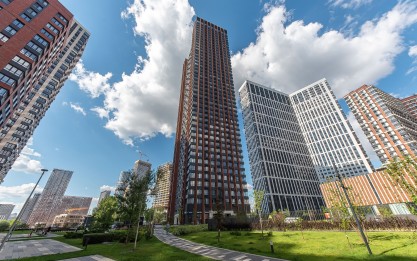
How to Determine the Class of a Residential Development: Differences Between Economy, Comfort, Business, Premium and Deluxe Real Estate
Why is the same residential project sometimes classified differently by different agencies?
The Moscow residential real estate market has become significantly more sophisticated in recent years. Buyers increasingly encounter situations where almost every new development is presented as “premium”, “luxury” or “business class”. Developers highlight architectural concepts, designer lobbies, landscaped courtyards and enhanced levels of comfort, yet these characteristics alone are not sufficient for a professional assessment.
The class of a residential property is determined not only by the price per square metre or the developer’s marketing strategy. It is a combination of factors that define the actual quality of the project: location, architecture, construction standards, engineering solutions, density, privacy, infrastructure, and property management.
This is why professional market participants may classify the same residential development differently. Some focus primarily on pricing and architecture, while others place greater importance on location, exclusivity, service levels and long-term investment potential.
Nevertheless, there is an established professional approach to residential classification used by analysts, consultants and real estate experts. It allows buyers to understand what they are actually purchasing and whether the property’s price corresponds to its real characteristics.
Why understanding property classes matters
Understanding the category of a residential development is important not only for buyers searching for a home but also for investors evaluating real estate as an asset.
The class of a property directly influences its liquidity, rental demand, price growth potential and resilience during market fluctuations. High-quality projects in strong locations with a well-developed concept traditionally demonstrate better value preservation over time.
For investors, the key question is not simply how much a square metre costs, but what exactly determines this price.
A high price does not automatically guarantee premium quality. Some properties may have elevated prices due to limited supply in a particular area, while lacking the characteristics of a truly premium product.
That is why professional real estate evaluation always requires a comprehensive analysis.
Main residential property classes in Moscow
The Moscow residential market is traditionally divided into five main segments:
- Economy class;
- Comfort class;
- Business class;
- Premium class;
- Deluxe class.
It is important to note that there is no official state classification system for residential property in Russia. The division into segments is based on professional market practice and the analysis of multiple characteristics.
Economy class: functionality and affordability
Economy-class housing represents the most accessible segment of the Moscow residential market. Its primary objective is to provide buyers with modern housing at an affordable price.
Modern economy-class developments differ significantly from traditional mass housing of previous decades. Many projects now offer landscaped courtyards, playgrounds, retail infrastructure on the ground floors and improved layouts.
However, the fundamental approach remains focused on efficiency and affordability. Developers optimise construction costs and maximise land utilisation. As a result, such projects typically feature higher density, a large number of apartments, standardised architectural solutions and a limited range of additional services.
Economy-class buyers primarily purchase functional housing rather than an exclusive living environment.
In Moscow in 2026, the average price level in this segment is approximately 250,000–400,000 RUB per square metre.
Representative projects include Salaryevo Park, Buninskiye Luga, Lyublinsky Park, Nekrasovka.
Comfort class: modern urban living environment
Comfort class has become one of the most popular segments of the Moscow residential market. This reflects changing buyer expectations: people increasingly want not only an apartment but also a high-quality urban environment.
Modern comfort-class projects offer landscaped car-free courtyards, pedestrian areas, sports facilities, stylish entrance halls and commercial infrastructure including cafés, shops and everyday services.
Compared with economy-class developments, greater attention is given to architecture and the overall concept of the neighbourhood. However, comfort class remains aimed at a broad consumer audience, which limits the level of privacy, engineering complexity and service compared with higher segments.
These projects usually lack the exclusive architectural concepts, limited supply and personalised services characteristic of premium developments.
The average price level in Moscow is approximately 350,000–550,000 RUB per square metre.
Examples include Skandinaviya, Ispanskiye Kvartaly, Prokshino, as well as selected phases of large-scale developments such as Symbol and ZILART.
Business class: the first level of premium living standards
Business class is one of the most diverse segments of the Moscow residential market. It is also the category where the boundaries between segments are most frequently debated.
The key difference is that a business-class apartment becomes part of a lifestyle rather than simply a residential unit.
Such projects typically feature better architecture, carefully planned environments, underground parking, modern engineering systems, security solutions, high-quality entrance areas and enhanced landscaping.
Public spaces play an increasingly important role. Contemporary business-class developments may include designer lobbies, co-working areas, fitness facilities, residents’ lounges and professional property management services.
At the same time, business class differs from premium real estate. These projects may have a larger number of apartments, higher density and less exclusivity.
The average price range in Moscow is approximately 550,000–900,000 RUB per square metre, although some projects are already approaching premium levels.
Notable examples include Hide, Symphony 34, FORIVER, RiverSky, Shagal, Level Prichalny and Sobytie.
Premium class: real estate as a lifestyle choice
Premium real estate represents a fundamentally different approach to residential property. Buyers are no longer purchasing only a home — they are acquiring a certain lifestyle, environment and level of exclusivity.
Premium developments are usually located in Moscow’s most prestigious districts and combine distinctive architecture, limited inventory, advanced engineering solutions and a high level of privacy.
At this level, details become crucial: air quality systems, acoustic comfort, security technologies, carefully designed public spaces, private leisure areas and professional management.
A true premium project creates a feeling of exclusivity not only inside the apartment but throughout the entire living environment.
The average price range in Moscow’s premium segment is approximately 1.2–2.5 million RUB per square metre.
Representative projects include Lucky, Badaevsky, Luzhniki Collection, Le Dome, Dom XXII, Savvin River Residence, Sky View and Opus.
Deluxe class: unique properties in the Moscow market
Deluxe is the rarest and most exclusive segment of residential real estate.
These properties represent more than high-quality housing — they are unique assets defined by architecture, location, history, privacy and exceptional scarcity.
Deluxe developments are usually located in Moscow’s most prestigious historic districts. The number of residences is extremely limited, and the level of service often approaches that of private residences.
These projects focus on individual layouts, panoramic views, premium natural materials, architectural value and complete confidentiality for residents.
Prices in the deluxe segment usually start from approximately 2.5–3 million RUB per square metre, while iconic properties may significantly exceed this level.
Examples include Nicole, Levenson, Chekhov, Turgenev, Bryusov 19, Ostozhenka 12 and Ilyinka 3/8.
Why the boundaries between property classes are becoming less clear
The residential market continues to evolve. Developers are improving the quality of mid-range projects, while many business-class developments increasingly incorporate premium-level features.
Today, a property cannot be evaluated solely by its advertised category or price per square metre.
A professional assessment must consider a combination of factors: location, surroundings, architecture, construction quality, engineering solutions, infrastructure, service levels and the future development potential of the area.
As a result, some projects naturally exist between two segments and may be perceived differently by various market participants.
Conclusion
The classification of residential real estate is not simply a marketing label. It reflects the actual quality of a project, the lifestyle it offers and its long-term investment potential.
Economy and comfort-class developments focus primarily on accessibility and functionality. Business-class projects introduce a higher level of comfort and living standards. Premium and deluxe properties represent a different philosophy, where privacy, service, exclusivity and uniqueness become the defining factors.
When choosing residential property, buyers should look beyond the price per square metre and understand what characteristics create that value.
A comprehensive professional approach allows buyers and investors to identify the true potential of a property — whether the goal is personal residence, capital preservation or long-term investment.