Demand in Moscow's Luxury Resale Housing Market Rises by 15 Percent
Behind this figure lies not an incidental surge but a systemic shift in the preferences of the solvent buyer. Ashtons International Realty examines who is purchasing, why the secondary market is the preferred choice, how pricing benchmarks are evolving, and what the segment may be expected to deliver through to year-end.
Why the Secondary Market Rather Than New Developments
An examination of premium buyer behaviour in Moscow over the past eighteen months reveals a systematic reallocation of capital away from projects under construction and towards completed housing. Several factors are at work, each operating independently yet converging to form a durable trend. The first is timing. Today's luxury buyer is, as a rule, unwilling to wait 24 to 36 months for the keys. The tasks at hand — a family relocation, an exit from rented accommodation, the swift deployment of capital into a tangible asset — demand an immediate outcome. A ready-to-occupy apartment in a boutique building on Patriarch's Ponds, on Ostozhenka, in Khamovniki, or in Presnya addresses these needs at once.
The second factor is the predictability of the result. On the secondary market, the buyer can assess the finished quality firsthand: the standard of fit-out, the performance of engineering systems, actual daylight levels, sound insulation, the view from the window, the composition of neighbours, and the effectiveness of the management company. In a new-build development, each of these parameters remains probabilistic: a project declaration offers no guarantee that the completed complex will look and function precisely as depicted in the renderings. In the luxury segment, where the cost of an error is measured in hundreds of millions of rubles, such predictability constitutes a value in its own right.
The third factor is the irreplaceability of the address. Moscow's luxury property market is structured in such a way that the finest addresses are already built out. New elite projects tend to rise on sites previously occupied by industrial facilities or less prestigious housing. A buyer who specifically seeks a residence in the heart of historic Moscow, with views of the Kremlin, the Moskva River, or Patriarch's Pond, will in all likelihood find the right property on the secondary market.
The Buyer Profile of 2026
According to Ashtons International Realty's analytics, demand for luxury resale property in early 2026 is shaped by three principal groups. The first comprises business owners aged 40 to 55 whose assets are concentrated in Moscow. For them, a prime apartment in the city centre represents a combination of personal residence, representational space, and capital-preservation instrument. Their transactions cluster in the range of 80 to 250 million rubles, settled from available cash or through dedicated private banking credit facilities.
The second group consists of second-generation wealth families, where parents are transferring funds for the purchase of a first premium-grade home. This cohort is distinguished by a high level of market awareness; many have studied the markets of London, Dubai, and Paris and are familiar with international standards of luxury housing. It is they who are generating demand for new formats: duplex apartments with terraces, home offices, dedicated guest bedrooms with en-suite bathrooms, and high-quality acoustic treatment. Their purchasing range falls between 60 and 150 million rubles.
The third group encompasses senior executives of major corporations and representatives of successful non-commodity-sector companies. This category of buyer expanded noticeably in 2024–2025, and in 2026 its share of total demand has reached, by our estimate, approximately 25 percent. These buyers acquire apartments in the 50 to 120 million ruble range, often favouring compact yet well-appointed units in prime locations — 120 to 170 square metres with two bedrooms, one of which may be converted into a study.
Which Districts Are Driving the Market Upward
The 15 percent rise in demand is distributed unevenly across districts. The leader in transaction growth within our portfolio is Khamovniki, where volumes increased by nearly 22 percent year on year. Yakimanka and Zamoskvorechye follow with growth of approximately 18 to 19 percent, and the Presnensky district — including locations around Patriarch's Ponds and Bolshaya Nikitskaya — recorded gains of roughly 16 to 17 percent. The classic luxury district of Ostozhenka and the Golden Mile posted growth of around 10 to 12 percent, constrained by objectively limited supply: no new construction is taking place, and existing owners are in no hurry to bring their properties to market.
Arbat, Plyushchikha, Novinsky Boulevard, and select addresses on Kudrinskaya also exhibit steady demand. Interest in the Tverskoy district and locations along the Boulevard Ring remains at the prior year's level, though a premium surcharge is beginning to form for buildings with secured grounds and enclosed courtyards — a parameter that in 2026 has become an almost mandatory requirement for buyers in the upper segment.
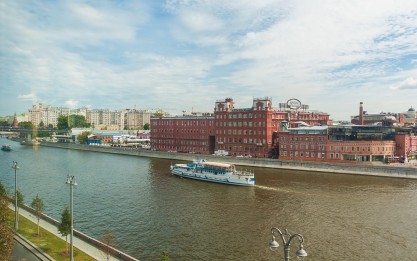
Separate mention should be made of the new luxury inventory emerging in locations that were industrial as recently as a decade ago: ZIL, Presnya-City, Krasny Oktyabr, and the Badaevsky area. Secondary supply appeared here relatively recently but is rapidly establishing its own price map. The price per square metre in quality buildings in these locations reaches 1.6 to 2.1 million rubles — figures comparable to those in the golden triangle of Khamovniki.
Price Dynamics: Uneven Yet Systemic Growth
Over the opening months of 2026, the weighted-average price per square metre on the secondary market in Moscow's luxury segment rose by approximately 6 to 9 percent relative to year-end 2025. The median transaction price, however, increased more sharply — by 11 to 13 percent. This divergence is explained by a shift in transaction structure: today's buyers are more readily pursuing higher-value and larger lots, which elevates the median ticket even amid relatively modest price-per-metre dynamics.
The strongest price gains were recorded for lots with distinctive characteristics: apartments offering views of landmark city landmarks, top-floor units with terraces, and apartments in boutique buildings housing no more than 50 families. In this sub-segment, appreciation reached 12 to 17 percent within the quarter. At the same time, a downward correction is underway for properties acquired in the overheated conditions of 2022–2023 — particularly in club buildings that have failed to deliver the promised level of service. Such units are selling at discounts of 5 to 10 percent below their acquisition price, and in some cases deeper still.
The price range of the earliest transactions of 2026 in our practice begins at 450,000 rubles per square metre (the lower boundary of the luxury segment in locations such as select addresses on Plyushchikha or in Zamoskvorechye) and extends to 2.3 to 2.7 million rubles per square metre in the most iconic club buildings of central Moscow. The median transaction price stands at approximately 185 million rubles, with the top 10 percent of deals exceeding 480 million rubles. These figures clearly illustrate the degree of heterogeneity within the segment and underscore how essential precise, address-level analytics are when setting a sale price or formulating an offer.
What Is Changing in the Product: New Expectations of Secondary-Market Buyers
The market is rapidly conditioning owners to meet a new set of buyer expectations. A decade ago, an opulent fit-out sufficed for a luxury apartment — marble, exotic hardwoods, European sanitary ware. Today this is no longer enough. The contemporary luxury buyer evaluates a complex array of parameters: climate-control scenarios, sound insulation between apartments and from the lift shaft, the quality of ventilation with heat recovery, the energy efficiency of the facade, the performance of the fresh-air preparation system, the readiness of the smart-home infrastructure, the electrical capacity of the floor with backup provision, and the availability of a dedicated concierge service.
Properties that satisfy this expanded checklist sell, on average, 20 to 25 percent faster than those offering merely a good renovation. This is precisely why 2026 has witnessed a surge in pre-sale preparation transactions: owners are investing in the modernisation of engineering systems, the renewal of furniture packages, and professional home staging — and are receiving a price premium that frequently exceeds the outlay by a factor of 1.5 to 2.
Transaction Velocity: Listing Periods Have Shortened
The average listing period for a quality luxury property in 2026 has contracted to 75 to 95 days. For comparison, in 2024 this figure ranged from 140 to 180 days. Apartments in iconic buildings sell especially rapidly: 30 to 50 days from listing to completion. Illiquid inventory, by contrast — awkward floor plans, extreme floors without terraces, units with problematic legal histories — remains on the market for 12 to 18 months and frequently requires a price reduction of 10 to 15 percent to achieve a result.
Ashtons International Realty observes an important trend: up to 30 percent of luxury-segment transactions in 2026 are conducted off-market, without the property ever entering the public domain. Buyers in the upper bracket prefer to work through a single specialist broker, to whom they entrust the parameters of their ideal property, and await proposals from the agency's proprietary database. This approach reduces search costs, guarantees confidentiality, and mitigates competitive pressure.
How Transaction Structure Has Evolved: Currency, Documentation, and Taxation
During 2024–2025, the market adapted to a new financial reality: settlements conducted exclusively in rubles, letter-of-credit arrangements through banks equipped to handle substantial sums, and fixed currency benchmarks agreed during negotiations with conversion to rubles at the exchange rate on the payment date. By 2026, these practices have become firmly established as standard. More than 90 percent of luxury-segment transactions are executed using bank letters of credit and non-cash transfers. Cash settlements have virtually disappeared even at the upper end of the market — a development for which the industry may thank the tightening of bank compliance requirements and the maturation of digital infrastructure.
The proportion of transactions registered to legal entities is growing. Approximately 18 percent of acquisitions in our practice in early 2026 are registered to Russian limited-liability companies created specifically to hold one or more properties. This structure addresses succession-planning objectives, facilitates the division of ownership among partners and family members, and simplifies the future disposal of the asset. In the bracket above 300 million rubles, the share of such structures reaches 35 to 40 percent.
A further significant shift is the heightened attention to the tax dimension of transactions. Buyers are increasingly asking the agency to provide a detailed calculation of total cost of ownership: property tax, utility charges, management company fees, insurance, and taxes upon subsequent sale after three and five years. We prepare such calculations in a standardised format for every property on which a client enters negotiations — this is an integral part of the agency's service.
Forecast Through to Year-End 2026
By our assessment, the number of transactions in Moscow's luxury resale segment will increase by 18 to 22 percent over the full year 2026 relative to 2025, while the median transaction price will rise by 12 to 16 percent. The drivers of growth will include the stabilisation of the macroeconomic environment, a gradual decline in the cost of capital, inflows from adjacent markets (business disposals, the repatriation of capital from foreign jurisdictions), and the broader trend of converting savings into tangible assets.
At the same time, we anticipate a widening of stratification within the segment. Quality addresses and lots will continue to appreciate, while irrelevant inventory will correct downward. Buyers should not be guided by average market growth but should instead work with the specific property and the specific price history of its address, entrance, and floor. It is for this reason that the selection of an agency with a deep data repository and analytical capability becomes a decisive factor in achieving a successful transaction.

Ashtons International Realty Recommendations
For buyers, we recommend acting decisively on genuinely liquid properties. In 2026, a good lot leaves the market within four to eight weeks, and the best within days. Define a precise profile of the ideal asset with the assistance of a professional broker, view eight to twelve properties within a compressed timeframe, and compare them against quantitative, legal, and qualitative criteria. Allow for a post-acquisition customisation budget: even in the finest lot, there will always be five to ten million rubles worth of adjustments that merit immediate attention upon completion.
For owners planning a sale, it is vital not to overvalue your property on the basis of market hearsay. The gap between market price and aspirational price typically costs the owner six to twelve months of exposure time and, on average, 10 to 15 percent of the final price. Ashtons International Realty conducts independent valuations drawing on a database of registered transactions, analysis of comparable listings, and an expert assessment of the optimal sales strategy — this is the first step in any successful transaction.
Moscow's luxury resale market in 2026 is a mature and pragmatic market, demanding professionalism, rigorous analysis, and a long-term perspective. Ashtons International Realty operates within this market as a strategic partner to the client, facilitating the right decisions at the right moment and providing support from the initial consultation through to the handover of keys and the ongoing management of the asset.